

YUGOSLAVIA JOINS AXIS PACT
Vienna, Austria • March 25, 1941
On this date in 1941 in Vienna, the government of Yugoslav regent Prince Paul signed a protocol of adherence to the Berlin-Rome-Tokyo Tripartite/Axis Pact, thereby setting the stage for a complex guerrilla war against Germans, Italians, and their Yugoslav allies, and within the Yugoslav resistance forces themselves. Not 2 days after aligning Yugoslavia with the Axis, elements in the Yugoslav military overthrew Prince Paul and proclaimed his 17‑year-old cousin, Prince Peter II, as king. The bloodless coup d’état—with the support of Britain’s clandestine Special Operations Executive—reflected the broad majority’s anti-Axis attitude in the country. A new cabinet announced a policy of neutrality, although a Yugoslav delegation would soon arrive in Moscow to sound out a potential Yugoslav-Soviet Treaty of Friendship and Nonaggression. The treaty, dated April 5, 1941, was duly signed in Moscow the next morning.
In Berlin Adolf Hitler was furious and lost little time raining bombs on Belgrade (Operation Retribution), the Yugoslav capital, killing 17,000 civilians in a series of air raids—the largest number of dead in a single day since the European conflict began in September 1939. Outmatched in the air and on the ground, the Yugoslav high command surrendered on April 17 as the country splintered—Croatia in the north of the country, where local nationalists had been stirred up by neighboring Italy, declared its independence as German bombs fell on Belgrade. Not until 3½ years later, on September 6, 1944, after smashing and occupying Romania and declaring war on neighboring Bulgaria, did the Allies in the form of the Red Army set foot on Yugoslav soil, pushing their way to the Dalmatian coast and linking up with Yugoslav Partisans, who for months had tied down a considerable number of German troops.
To the south of Yugoslavia, British airborne forces had descended on Greece (September 24, 1944) and advanced on Athens, liberating the capital on October 13. On October 19, German forces, holed up in Belgrade for half a week, fled the ruined capital, which was occupied by Soviet troops and Josip Tito’s Yugoslav Army on October 20.
That same week, October 9–19, 1944, British Minister Winston Churchill was in Moscow for discussions with Soviet leader Joseph Stalin. The 2 men adopted the Percentages Agreement, whereby the 2 Allies divided the Balkan region into spheres of influence. Under terms of the agreement, the Soviets would predominate in Romania, Bulgaria, and Hungary—Axis countries where the Red Army had been or would soon be, while Great Britain would assume power in Greece. Both countries would share influence in Yugoslavia. President Franklin D. Roosevelt, upon learning of the agreements reached by Churchill and Stalin, announced that his administration would not be bound by the terms.
Yugoslavia in World War II
 |
 |
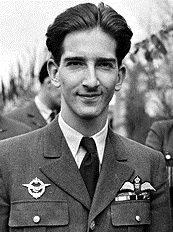
Left: King Peter II of Yugoslavia wearing the uniform of the Royal Air Force, January 1944. On March 27, 1941, Peter, then 17, was proclaimed of age, ascended the Yugoslav throne (empty since the assassination of his father King Alexander in Marseilles, France, in 1934), and participated in a British-supported coup d’état opposing the Tripartite Pact. Peter (reign: 1934–1945) was forced to leave the country with the Yugoslav government following the Axis invasion by German, Italian, Hungarian, and Bulgarian armies. He and his government ministers hopscotched to Greece, then to Jerusalem in the British Mandate of Palestine, then to Cairo, Egypt, eventually winding up in England in June 1941. There he and his ministers rubbed elbows with numerous other governments in exile from Nazi-occupied Europe. The teenage king completed his education at Cambridge University and joined the Royal Air Force. His uncle Prince Paul spent the war years under house arrest in South Africa.
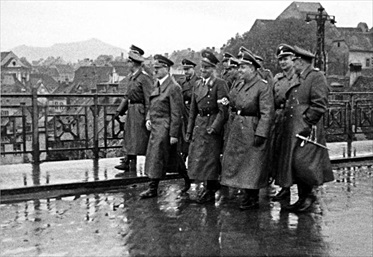
Right: Hitler in the company of his press secretary and the chief of his chancellery crossing the Old Bridge (Stari most) in Marburg an der Drau (Maribor), occupied Yugoslavia (in today’s Northeastern Slovenia), 1941.
 |
 |
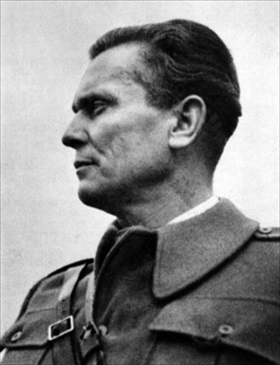
Left: Partisan supreme commander Marshal Josip Broz Tito, 1942. Tito’s formidable communist-leaning guerrilla force, concealed in rural villages, the countryside, and mountain strongholds, was a constant thorn in the side of the Wehrmacht (German armed forces), prompting numerous anti-Partisan operations and much bloodshed.
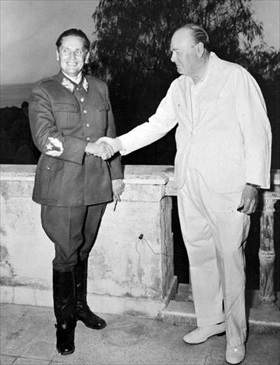
Right: Tito and British Prime Minister Winston Churchill, keeping his distance, pose for the camera in Naples, Italy, 1944. Churchill publicly called it his biggest wartime blunder—shifting British and tag-along U.S. support from Yugoslavia’s Gen. Draža Mihailovic (also spelled Draja Mihailovich) and his royalist resistance group called the Yugoslav Army of the Homeland, better known as Chetniks, to Tito and his Partisans. (In 1997 the world learned that the Allied switch of allegiance away from Mihailovic was orchestrated largely by a confirmed Soviet mole who had infiltrated both the British and the American covert intelligence services to besmirch Mihailovic’s and the Chetniks’ anti-German bona fides.) Mihailovic’s Chetniks clashed with Partisan and Wehrmacht units alike. The Partisans eventually got the better of the Chetniks and the Axis enemy. Mihailovic was captured at his hideout in March 1946, tried and convicted of high treason and war crimes, and executed by firing squad in Belgrade on July 17, 1946. Sixty-nine years later the Mihailovic verdict was overturned by the Serbian supreme court on grounds it was politically and ideologically motivated.
Multiple Yugoslav Resistance Movements Unleash Series of Tragedies—the Early Years

World War II was the single most devastating and horrific event in the history of the world, causing the death of some 70 million people, reshaping the political map of the twentieth century and ushering in a new era of world history. Every day The Daily Chronicles brings you a new story from the annals of World War II with a vision to preserve the memory of those who suffered in the greatest military conflict the world has ever seen.